
Breakdown and Resolution (1943)
Winston Churchill and Alan Brooke argued their way to victory

General Alan Brooke, later Field Marshall and 1st Viscount Alanbrooke of Brookeborough, served as Chief of the Imperial General Staff (CIGS) from 1941 to 1946, under both Winston Churchill and Clement Attlee. His diaries were so sensitive that they did not appear in complete and unexpurgated form until 2001, in Lord Alanbrooke’s War Diaries 1939-1945, edited by Alex Danchev and Daniel Todman (Orion Press, London).
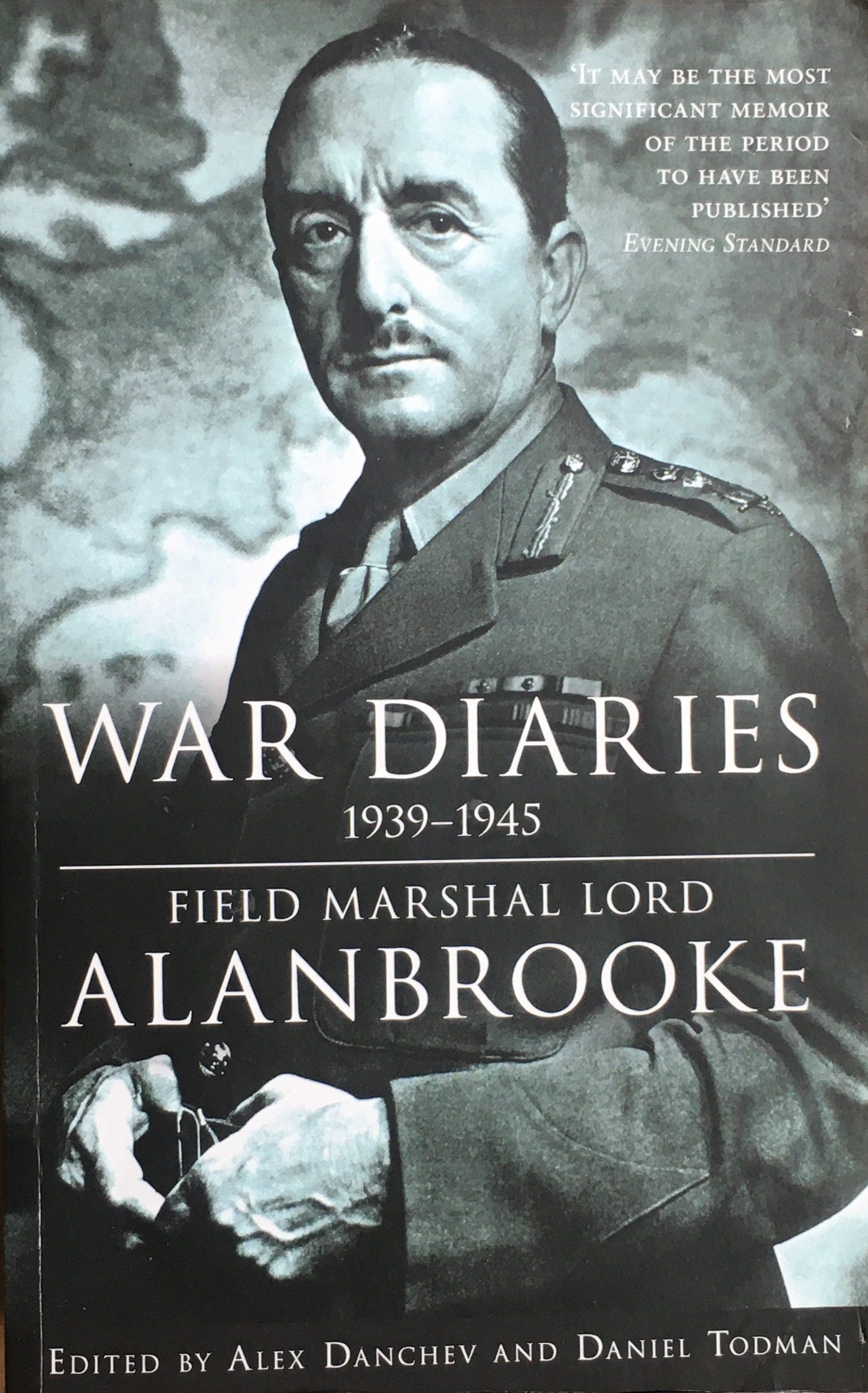
Brooke’s diary entry for December 9, 1943 is unsettling even now. Churchill and Brooke were on their way back to London from Teheran, where the first of the Big Three strategy conferences with Roosevelt and Stalin had just taken place. They were traveling by way of North Africa, which had been cleared of German forces six months before.
Brooke describes a private lunch with Churchill , which consisted mostly of Churchill eating soup with a spoon in one hand and a fly-swatter in the other. Every few seconds, Churchill would kill a fly, and add it to a pile of dead flies he had arranged on a corner of the table. His conversation with Brooke was confused and repetitive, and Brooke wondered in his diary “how near he was to a crash, and how serious that crash would be”.
The Big Three meetings in Teheran had been held at the Soviet Embassy. There had been much eating and drinking in the Russian style. Everyone had found it exhausting, and Churchill’s doctor (Lord Moran) made a point of speaking to Brooke about Churchill’s state of health.
It turned out, however, that Churchill had come down with pneumonia, brought about in part by stress and exhaustion. This was serious. but not as irretrievable as a nervous breakdown made worse by drinking. His chances of survival were good, especially with expert care, although the only treatment for pneumonia at that time was based on sulfa drugs, themselves developed only a few years earlier in Germany.
Churchill was out of action for several weeks. First for treatment, then to recuperate in Marrakesh before returning to London on January 18, 1944
In the week before Churchill’s return, Brooke met with King George VI at Sandringham, the royal estate a hundred miles north of London on the Norfolk coast. He came for an extended weekend of grouse shooting, but on two of the four days that he stayed there, Brooke records that he talked at length with the King about the progress of the war, and about Churchill himself.
Brooke’s tone is very discreet, but we get the feeling that a major crisis has been averted. There would be other crises in the future, but none that required a second visit to Sandringham, and none that required so long a time in consultation with the King.
For those who think about strategy in terms of Sun Tzu and the Art of War, it’s tempting to imagine Churchill as the Emperor and Brooke as the General. Or, perhaps, Churchill as the General and King George VI as the Emperor (since he was in fact a genuine emperor). Yet neither of these would get the picture quite right.
The relationship between Churchill and Brooke was one of constructive disputation. A mentally weakened Churchill might still have been able to lead, but not in the way that the two men had found so successful.
Churchill had enormous power as Prime Minister of Britain’s Coalition Government, where he also served as Minster of Defence, but he had long been a controversial figure. He had started in politics as a Conservative, but he left the Conservative Party for the Liberal Party in 1904. He returned to the Conservatives two decades later, in 1924, but remained an outsider. He became Prime Minister of the wartime Coalition Government because Labour would not accept anyone who had been associated with Neville Chamberlain and his pre-war policy of Appeasement.
As the leader of the Coalition Government, Churchill had to collaborate with the Labour Party and what was left of the Liberals. Later in the war, he had to collaborate with Roosevelt, and to a lesser degree with Stalin. Churchill had to lead by persuasion.
Brooke also had to lead by persuasion. He might have been Chief of the Imperial General Staff, but Britain had almost 400 generals in its Army, and many more officers of equal rank in its Navy and Air Force. There were also officers from Commonwealth forces who reported to their own governments and could not be ordered around at will. Like Churchill, Brooke had to collaborate with his American counterparts, and to a lesser degree, with those in the Soviet Union.
Brooke also faced a slightly different problem, which he first mentions in his diary on March 31, 1942, a few months after his appointment as CIGS:
“[We have a] lack of good military commanders: Half our Corps and Divisional Commanders are totally unfit for their appointments, and yet if I was to sack them I could find no better! They lack character, imagination, drive and power of leadership. The reason for this state of affairs is to be found in the losses we sustained in the last war of all our best officers, who should now be our senior commanders.”
Brooke did not want officers who merely obeyed orders, and neither did Churchill. Brooke himself had been carefully chosen, and as Churchill expressed himself at the time:
“When I thump the table and push my face towards him what does he do? Thumps the table harder and glares back at me. I know these Brookes – stiff-necked Ulstermen and there’s no one worse to deal with than that!” [Churchill had served in the cavalry with Alan Brooke’s older brother Vincent in India during the 1890’s.]
Churchill was often dissatisfied with the performance of Britain’s generals, and one of Brooke’s greatest contributions to the war effort lay in the selection and assignment of senior officers, and the inevitable smoothing out of difficulties.
The aggressive fighters had to be paired with the meticulous planners, the bull-headed with the tactful. Or, sometimes, the forceful with the equally forceful, as with himself and Churchill. Brooke had to defend his appointments as they passed in and out of Churchill’s favor, since he knew how little he had in the way of alternatives.
A few weeks before the Big Three conference in Teheran, Churchill had remarked to his secretary Marian Holmes, that ‘The difficulty is not winning the war; it is in persuading people to let you win it—persuading fools.” He admitted to her that he felt “almost like chucking it in.”
Brooke was no fool, and Churchill knew it. But for all their mutual respect, it was not an easy relationship. Late 1943 and early 1944 brought it to its lowest point.
Brooke’s visit to Sandringham must have brought him to a calmer state of mind. In his diary (written at the time) he talks mostly about the grouse shooting and the happiness of the King and Queen in their family life. In the notes he added later, he writes about receiving apples from the Royal Orchards. His driver had been previously in service at Sandringham, and knew who to talk to about getting a case or two before they went to market.
Brooke’s sense of calm would soon be tested. On January 19, 1944, on Churchill’s first full day back from Marrakesh, Brooke writes:
“The PM is starting off in his usual style!! We had a Staff meeting with him at 5:30pm for two hours, and a Defence Committee from 10:30pm for another two hours. And we accomplished nothing!! I don’t think I can stand much more of it. We waffled about with all the usual criticisms, all the usual optimist’s plans, no long term vision, and we settled nothing. In all his plans he lives from hand to mouth. He can never grasp a whole plan, either in its width (i.e. all fronts) or its depth (long term projects). His method is entirely opportunist, gathering one flower here another there! My God how tired I am of working with him! I had not fully realized how awful it is until I had been thrown into it again after a rest!”
But through all this, the two men persevered. They both led by persuasion, and their ability to persuade each other in rational argument was perhaps the key to their persuasion of others.
A year later, in his diary entry for January 25, 1945, Brooke writes about his frustration with Churchill’s reluctance to draw down forces on the Italian front, in preparation for the final assault on Germany. But later, he adds this note:
“To the continued abuse that I find on almost every page of my diary, I am perhaps conveying a false impression of my relations with him and my feelings for him. Throughout all these troublesome times I always retained the same unbounded admiration. and gratitude for what he had done in the early years of the war. One could not help also being filled with the deepest admiration for such a genius and super man. And mixed with it all there were always feelings of real affection for the better side of him. In reading these diaries it must be remembered that I had a long and trying time with him and that the writing of this diary presented the only safety valve that I had to pent up feelings of irritation which I could share with no one else.”
To which we might add this thought from Churchill:
“Battles are won by slaughter and maneuver. The greater the general, the more he contributes in maneuver, the less he demands in slaughter.”
A discussion of moves to surprise the enemy might very well seem like “a flower here, a flower there”. And despite Brooke’s note that day, there are many entries in his diary where he doesn’t complain about Churchill’s lack of strategic vision. Some of the flowers must have been useful.
Consider this thought from Sun Tzu, in Chapter 5 of the Art of War, Strategic Advantage (quoted from the Ballantine translation):
“Generally in battle use the “straightforward” to engage the enemy and the “surprise” to win the victory. Thus the expert at delivering the surprise assault is as boundless as the heaven and earth, and as inexhaustible as the rivers and seas. Like the sun and the moon, he sets only to rise again; like the four seasons, he passes only to return.”
Churchill was a man of many surprises. Brooke was the man who made it possible for Britain’s soldiers to deliver them. We might not think of argument as the key to winning wars, but here’s a final thought to consider, which Churchill placed on the frontispiece of his six volume History of the Second World War.
    In war: resolution.
    In defeat: defiance.
    In victory: magnanimity.
    In peace: goodwill.
Resolution has more than one meaning. I like to think that Churchill, a true master of words, had more than one of them in mind.
To learn more:
Lord Alanbrooke’s War Diaries 1939-1945, edited by Alex Danchev and Daniel Todman, was published in 2001 by Orion Press in London. The book is available from all the usual sources, in hardback, paperback and electronic form. I strongly recommend getting it in electronic form. This makes it easier to search for related elements across six years of daily entries, and to re-find the small but significant items that didn’t make it into Danchev and Todman’s otherwise excellent index.
Alan Brooke was born in 1883 at Bagnères-de-Bigorre, a town in the foothills of the Pyrenees in southern France, the seventh and youngest son of Sir Victor Brooke, 3rd Baronet, of Colebrooke Park, Brookeborough, County Fermanagh.
Alan Brooke entered the Royal Military Academy at Woolwich in 1900 and received his commission in the Royal Artillery in 1902. He served in the British Army from 1902 until his retirement in 1946. He held a number of important commands, including Chief of the Imperial General Staff (CIGS) during the Second World War, where he was promoted to Field Marshal in January of 1944. At the close of the war, he was granted a life peerage as Viscount Alanbrooke of Brookeborough. He passed away peacefully in 1963 at the age of 79.
For additional information, Danchev and Todman cite a number of authors who recounted their personal experiences with Churchill. Notable among them are Charles McMoran Wilson, 1st Baron Moran (Churchill’s doctor), Sir John Colville (Churchill’s principal private secretary) and Major-General Sir John Kennedy (Assistant Chief of the Imperial General Staff).
There are many biographies of Winston Churchill, and other books in which he plays a significant role. The International Churchill Society is a good starting point.
The Wikipedia, as always, is a great source of information on the officers and military formations of all the belligerents, as well as the campaigns and many of the individual battles.
For the medically inclined, the U.K. National Health Service has made a number of papers on Winston Churchill’s health available through its National Library of Medicine website. One of these is In Carthage ruins: the illness of Sir Winston Churchill at Carthage, December 1943, by J.A. Vale and W. Scadding, originally published in the Journal of the Royal College of Physicians of Edinburgh in September of 2017.
The Ballantine translation of Sun Tzu appears in The Book of War, published in paperback edition in 2000 by Modern Library, a registered trademark of Random House, Inc. ISBN 978-0-375-75477-7. The book contains The Art of War translated from the Chinese, and On War, by Karl von Clausewitz, translated from the German, along with a large amount of reference material.
In the coming year the yubik.com strategic engineering newsletter will publish more articles about how strategy gets created in real life.